How to Build a Hybrid Step 1 Study Plan
You need a tactical mix of tools to pass. Subject-specific question banks expose knowledge gaps quickly. Condensed revision guides only help during final review. Combine both for maximum score gains.
Expert reviews of Step 1 books. Compare question banks and revision guides for weak-area remediation and score maximization.
You need a tactical mix of tools to pass. Subject-specific question banks expose knowledge gaps quickly. Condensed revision guides only help during final review. Combine both for maximum score gains.
Preclinical students who need to translate symptom clusters into rapid USMLE diagnoses.
It links classic vignettes directly to underlying science, building diagnostic reasoning faster than rote memorization.
Vignette-to-explanation structure actively builds diagnostic reasoning skills and improves self-assessment scores.
Highly effective for visual and case-based learners preparing for standardized clinical testing formats.
Emphasizes pattern recognition by presenting classic vignettes with expected history, physical exam, and lab findings.
Ideal for students transitioning from basic sciences to clinical correlations in preclinical years.
M1 students who struggle to connect gross anatomy to clinical presentations.
The award-winning illustrations and patient images force you to interpret visual data like the actual exam.
>600 USMLE/COMLEX-style Qs, mirror exam format, image extraction practice, online tool for customized review.
Best for high-yield practice requiring exam-format familiarity and immediate feedback.
>600 Qs across easy/mod/hard, in-depth lymphatic/endocrine coverage, comprehensive explanations, visual anatomy integration.
Suitable for comprehensive basic science review targeting applied anatomical knowledge for licensure.
Students who need to master tissue structure and developmental pathways for board exams.
Questions push past simple recall into two-layer clinical applications, mirroring NBME difficulty.
Difficulty stratification aids progressive learning, explanations clarify misconceptions, organized sections enable focused review.
Best for independent study, used alongside lectures to solidify concepts through spaced retrieval practice.
Covers cell biology, all major tissue systems, and embryological development per standard anatomical sciences curricula.
Best for M1/M2 coursework reinforcement, used to map learning to standard anatomical science modules.
M2 students preparing for dedicated exam blocks who need rapid disease process review.
Over 1,000 questions cut straight to high-yield mechanisms and efficiently refute common distractors.
High-yield MCQs with difficulty grading and explicit learning objectives. Explanations justify correct answers and refute distractors efficiently.
Best for medical students utilizing question-based active recall to identify knowledge gaps before board exams.
Over 1,000 questions require integrated knowledge of basic sciences and disease processes. Difficulty scales from diagnosis to complex pathophysiology.
Effective for foundational review and high-yield concept mastery prior to standardized testing.
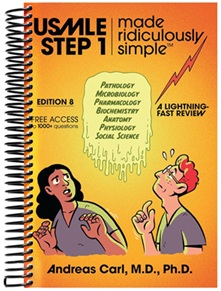
Candidates in their last two study weeks who need a quick fact refresher.
The spiral-bound chart layout lets you flip through massive topics in minutes without reading dense prose.
Spiral-bound, portable, and concise; includes free online question bank for self-testing on the go.
Perfect for final review weeks and last-minute cramming; not a standalone resource.
High-yield focus condenses vast basic sciences into manageable charts for rapid recall.
Only for final review after in-depth study; not for initial learning or deep understanding.
Anxious test-takers who need structured pacing tips and full-length simulation practice.
It focuses on exam mechanics like time management and educated guessing, which directly protect your score.
Packed with test-taking secrets, time-saving strategies, and a full-length practice test to mimic exam conditions.
Ideal for exam-focused medical students seeking strategic tips and quick content refreshers alongside primary resources.
Simple, jargon-free language and online video walkthroughs cater to varied learning speeds and styles.
Best for auditory and read-write learners who can leverage video explanations to cement concepts.
Pick the format that matches your current study bottleneck.
Fast chart review for final weeks, but too shallow for deep learning.
Deep active recall for weak areas, but slower to move through.
| Comparison Point | USMLE Step 1 Made Ridiculously Simple | Thieme Test Prep for the USMLE®: Pathology Q&A |
|---|---|---|
| Edition | 8 | 1 |
| Page Count | 424 pages | 849 pages |
| Primary use case | Last-minute fact refresh | Targeted weak-area remediation |
| Main trade-off | Lacks mechanistic depth | Requires more study time |
| Knowledge Depth |
2.0/5
High-yield focus condenses vast basic sciences into manageable charts for rapid recall.
Only for final review after in-depth study; not for initial learning or deep understanding.
|
4.0/5
Over 1,000 questions require integrated knowledge of basic sciences and disease processes. Difficulty scales from diagnosis to complex pathophysiology.
Effective for foundational review and high-yield concept mastery prior to standardized testing.
|
| Practical Application |
4.0/5
Spiral-bound, portable, and concise; includes free online question bank for self-testing on the go.
Perfect for final review weeks and last-minute cramming; not a standalone resource.
|
4.0/5
Organized by organ system with dedicated mixed-item chapters. Easy navigation with subheadings for focused review of difficult topics.
Best for in-depth self-assessment during course rotations or dedicated exam preparation phases.
|
We scored each title on curriculum alignment, explanation clarity, and real-world study efficiency. We prioritized resources that force active recall over passive reading.
Pair one subject-specific question bank with one condensed revision guide for your final weeks. Use the bank to expose weak areas, then swap to the guide only when you need rapid fact checks.
Start with targeted question banks to close your knowledge gaps. Switch to chart reviews only when exam day approaches.