Choosing Between Operative Handbooks and Atlases
Operative handbooks and atlases serve different jobs. Here is how to pick the right one for your training stage and budget.
Compare the Oxford Handbook of Operative Surgery with surgical atlases to decide which fits your training needs and budget.
Operative handbooks and atlases serve different jobs. Here is how to pick the right one for your training stage and budget.
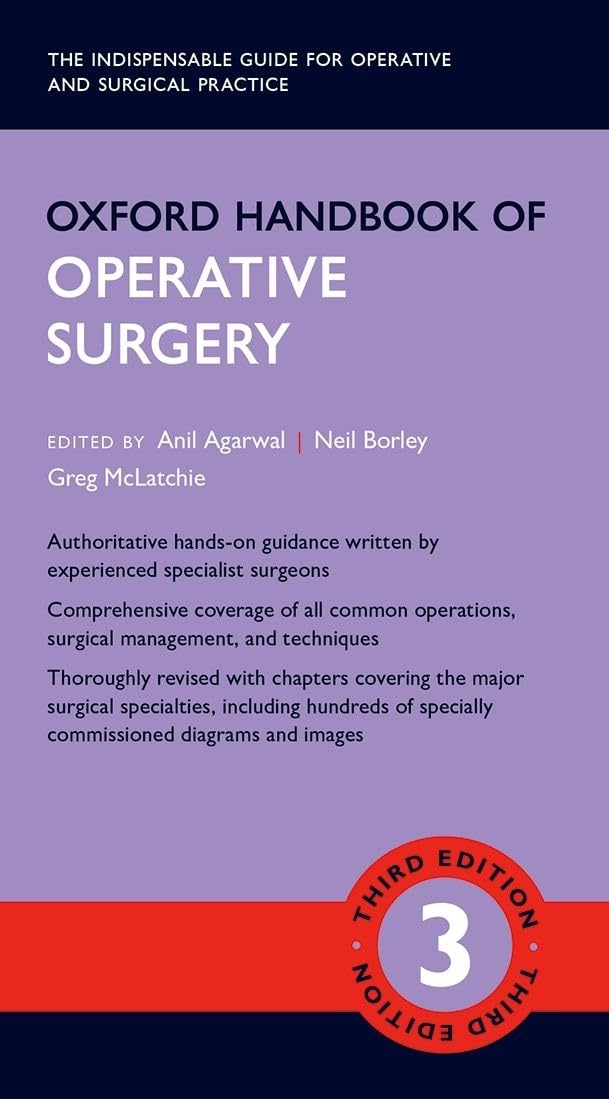
Core surgical trainees who need rapid, portable step-by-step guidance during a case.
Pocket-sized with 300+ diagrams and tips from 30 surgeons. Aligns with the intercollegiate curriculum (curriculum alignment score: 5.0).
Portable, pocket-sized format with 300+ diagrams; step-by-step equipment and technique guidance for the OR.
Perfect for scrubbed trainees who need immediate, actionable procedural steps.
Explicitly mapped to the intercollegiate surgical curriculum across 10 specialties; updated to reflect modern training.
Essential for core surgical trainees aligning study with curriculum-defined operations.
Advanced residents and fellows focusing on minimally invasive esophageal procedures.
Includes 200+ color illustrations that are more detailed than the Oxford Handbook's diagrams, making it better for visual learners during complex MIS cases. Step-by-step instructions for common MIS esophageal procedures come with evidence-based tips for managing complications.
Evidence-based, expert-authored pearls cover indications, perioperative management, and detailed technique for the full spectrum of esophageal diseases.
Best for practicing general and foregut surgeons seeking up-to-date, authoritative technical guidance for MIS esophageal procedures.
Easily understandable format, color illustrations, and stepwise instructions aid rapid skill acquisition for trainees.
Ideal for advanced residents, fellows, and general surgeons transitioning to MIS esophageal procedures.
Experienced laparoscopic surgeons who want to adopt single-incision techniques.
Real-time operative images from 2000 cases provide rare, practical tips that are not available in general handbooks, including actionable advice for complication management.
Well-organized by organ system, quick lookup for specific SILS procedures.
Use as a desktop reference for classic single-incision laparoscopy, cross-check with updates.
Step-by-step photos and tips directly applicable to the operating room.
Ideal as a supplementary guide alongside contemporary equipment updates.
Match the format to the moment: quick reference vs. visual deep-dive. The key differences are summarized below.
Best for fast, portable reminders when you are scrubbed in.
Best for detailed, illustrated steps when you have time to study.
Best for advanced laparoscopic surgeons seeking specialized techniques.
| Comparison Point | Oxford Handbook of Operative Surgery | Atlas of Esophageal Surgery | Atlas of Single-Incision Laparoscopic Operations in General Surgery |
|---|---|---|---|
| Edition | 3 | 2 | 1 |
| Page Count | 1022 pages | — | — |
| Best for | On-shift quick reference | Off-shift visual study | Advanced technique adoption |
| Depth | Concise, broad coverage | Deep, specialty-specific detail | Deep, single-technique focus |
| Portability | Pocket-sized | Large atlas format | Large atlas format |
| Audience | Core surgical trainees | Advanced residents/fellows in MIS esophageal | Experienced laparoscopic surgeons |
| Key Strength | Curriculum alignment (score 5.0) | 200+ color illustrations | Real-time images from 2000 cases |
| Key Limitation | Limited visual detail; lower reference quality | Narrow scope (MIS only) | Requires prior experience; dated data |
| Practical Application |
5.0/5
Portable, pocket-sized format with 300+ diagrams; step-by-step equipment and technique guidance for the OR.
Perfect for scrubbed trainees who need immediate, actionable procedural steps.
|
5.0/5
Operative focus with tips, pearls, patient positioning, and perioperative strategies enables immediate clinical application.
Perfect for surgeons preparing for an MIS esophageal case who need a rapid, illustrated …
|
3.0/5
Step-by-step photos and tips directly applicable to the operating room.
Ideal as a supplementary guide alongside contemporary equipment updates.
|
| Learning Effectiveness |
4.0/5
Pre- and post-operative reading aid; tips and tricks from experienced surgeons accelerate skill acquisition.
Good for early-year trainees rotating through specialties who need rapid, case-specific learning.
|
4.0/5
Easily understandable format, color illustrations, and stepwise instructions aid rapid skill acquisition for trainees.
Ideal for advanced residents, fellows, and general surgeons transitioning to MIS esophageal procedures.
|
4.0/5
Real-time operative images and 'tips and tricks' foster visual learning and skill transfer.
Maximize uptake by pairing with live workshops and video-based tutorials.
|
We scored each book on practical application, learning effectiveness, and curriculum alignment. Note that curriculum alignment scores are only available for the Oxford Handbook; the atlases were not scored on that criterion, as they are not designed for curriculum review. We weighed how often a trainee would realistically use it in the OR versus the study desk.
Start with one quick-reference handbook for everyday cases. Add a specialty atlas when you rotate into a subspecialty or need deeper visual guidance. Avoid buying both atlases at once unless you do high-volume MIS work.
The Oxford Handbook is the best first buy for most trainees. It is portable and aligns with the curriculum. Add an atlas only when you need deeper visual detail for a specific subspecialty. For esophageal-focused trainees, the Esophageal Atlas is a valuable supplement; for experienced laparoscopists, the Single-Incision Atlas offers advanced techniques but requires prior experience.