Key Takeaways

  • Match the book to your stage: exam prep needs a question bank, the OR needs a handbook.
  • The Oxford Handbook scores 5.0 on curriculum alignment and practical application, making it a strong OR reference; Cases for Surgical Finals scores 4.0 on learning effectiveness, making it a solid exam tool.
  • Each book has trade-offs: the handbook lacks exam-style questions, while the question bank lacks procedural detail.

Choosing a Surgical Reference That Fits Your Stage

For written exams, active recall through question practice is key; for the operating room, quick procedural steps are essential. This review compares two popular resources: the Oxford Handbook of Operative Surgery, which covers 300+ procedures with step-by-step illustrations, and Cases for Surgical Finals, which offers 330+ questions in SAQ, EMQ, and MCQ formats. Using specific scores, we help you decide which fits your current stage.
How We Evaluated These Resources

We scored each book on curriculum alignment, practical application, learning effectiveness, and clinical relevance. We weighed evidence from analysis scores and user feedback. The Oxford Handbook scored 5.0 on curriculum alignment and practical application, and 4.0 on reference quality. Cases for Surgical Finals scored 4.0 on learning effectiveness, curriculum alignment, and pedagogical quality. These scores reflect each book's intended role.

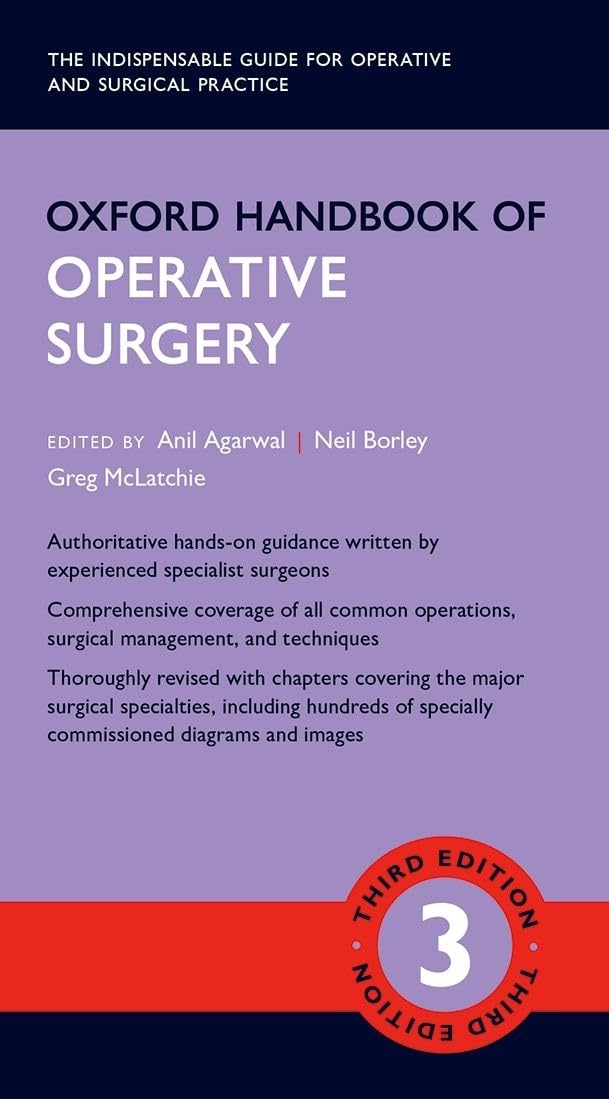
Oxford Handbook of Operative Surgery

Best OR Companion: Operative Handbook

★ 4.5/5
Anil Agarwal, Neil R. Borley, Greg R. McLatchie

Who This Is For

Core surgical trainees and junior doctors who need quick procedural steps while scrubbed.

Why It Stands Out

Pocket-sized with 300+ step-by-step illustrations for common procedures like appendectomy, which can be quickly referenced while scrubbed. It scores 5.0 on curriculum alignment and practical application, and 4.0 on reference quality, making it a strong OR reference.

Concise by design; lacks deep anatomical detail for complex or rare cases. It is not a question bank and does not include exam-style questions or formats.

Expert Angles

Practical Application

5.0/5

Portable, pocket-sized format with 300+ diagrams; step-by-step equipment and technique guidance for the OR.

Perfect for scrubbed trainees who need immediate, actionable procedural steps.

Curriculum Alignment

5.0/5

Explicitly mapped to the intercollegiate surgical curriculum across 10 specialties; updated to reflect modern training.

Essential for core surgical trainees aligning study with curriculum-defined operations.

Cases for Surgical Finals

Best Exam Practice: Finals Question Bank

★ 3.5/5
Helen Cheshire, Philip Stather

Who This Is For

Medical students and MRCS candidates who need varied question practice across all surgical specialties.

Why It Stands Out

Over 330 questions in SAQ, EMQ, and MCQ formats, divided by subspecialty, allowing targeted practice for weak areas. Scores 4.0 on learning effectiveness, curriculum alignment, and pedagogical quality.

Published in 2011, so content may not match current guidelines or curricula. It is not designed for intra-operative reference and lacks step-by-step procedural diagrams.

Expert Angles

Learning Effectiveness

4.0/5

User-friendly with short questions, multiple formats, and explanatory answers to reinforce learning.

Effective for active recall and exam simulation; combine with current texts.

Curriculum Alignment

4.0/5

Comprehensive alignment with undergraduate surgical finals and MRCS syllabi across multiple specialties.

Best used alongside updated resources to ensure curriculum currency.

Head-to-Head: Exam Prep vs. OR Ready

The choice depends on your primary need: passing finals or performing in the OR. Here is a detailed comparison based on our evaluation scores.

Finals Question Bank
Cases for Surgical Finals
Helen Cheshire, Philip Stather

Best for written exam practice and knowledge scanning.

Operative Handbook
Oxford Handbook of Operative Surgery
Anil Agarwal, Neil R. Borley, Greg R. McLatchie

Best for real-time procedural support and curriculum alignment.

Comparison Point Cases for Surgical Finals Oxford Handbook of Operative Surgery
Edition 1 3
Page Count 164 pages 1022 pages
Primary strength Active recall and exam simulation (learning effectiveness 4.0) Step-by-step operative guidance (practical application 5.0)
Main trade-off No procedural or hands-on content Too concise for deep understanding; lacks exam-style questions
Curriculum alignment 4.0 5.0
Practical application Not rated 5.0
Practical Application
1.0/5
None; no operative or hands-on content.
Avoid for practical surgical training; only for written exam preparation.
5.0/5
Portable, pocket-sized format with 300+ diagrams; step-by-step equipment and technique guidance for the OR.
Perfect for scrubbed trainees who need immediate, actionable procedural steps.
Learning Effectiveness
4.0/5
User-friendly with short questions, multiple formats, and explanatory answers to reinforce learning.
Effective for active recall and exam simulation; combine with current texts.
4.0/5
Pre- and post-operative reading aid; tips and tricks from experienced surgeons accelerate skill acquisition.
Good for early-year trainees rotating through specialties who need rapid, case-specific learning.
If your exam is within weeks, prioritize the question bank. If you are in the OR now, the handbook is essential. Many trainees benefit from owning both, but start with the one that matches your immediate stage.

Limitations and Trade-offs

Both books have limitations. The Oxford Handbook is not a question bank, so it offers no practice questions for exam prep. Cases for Surgical Finals, while strong for exam practice, does not provide step-by-step procedural guidance for the OR. Additionally, the handbook's concise format may not suit deep learning, and the question bank's 2011 publication may not reflect current guidelines.

Building Your Resource Collection

Start with one strong clinical reference like the Oxford Handbook for daily OR use. Add a question bank like Cases for Surgical Finals only for exam season. Do not rely on a single book for both roles, as each has distinct strengths and limitations.

Final Verdict

For long-term clinical use and OR reference, the Oxford Handbook of Operative Surgery is the stronger investment, given its high scores in curriculum alignment and practical application. However, if your immediate goal is passing surgical finals, Cases for Surgical Finals offers effective exam practice with a 4.0 learning effectiveness score. If you are a final-year medical student, prioritize Cases for Surgical Finals; if you are a junior doctor in the OR, the Oxford Handbook is essential. For those with budget, owning both covers both needs.

Compare your options by stage and need before you buy.