Key Takeaways

  • First Aid books work best as rapid review tools, not primary learning sources.
  • Pick the edition with the strongest curriculum alignment for your specialty; skip the rest.

How to Choose a First Aid Board Review Book

First Aid has grown from USMLE prep to specialty board reviews. These editions—Family Medicine and EM in third editions, Internal Medicine in its fourth edition—promise high-yield facts, but they vary in accuracy and depth. Here is what works.
First Aid for the Family Medicine Boards, Third Edition

Best Overall: Family Medicine Third Edition

★ 4.2/5
Diana Coffa, Tao Le, Michael Mendoza, Lamercie Saint-Hilaire

Who This Is For

Family medicine residents and physicians preparing for ABFM in-service or board exams who want a fast, high-yield review.

Why It Stands Out

Tight alignment with the ABFM blueprint (curriculum alignment score 4.0), a full-color layout with numerous mnemonics and margin notes, and a structured design that supports high retention for rapid recall. Its learning effectiveness score of 4.0 indicates strong pedagogical support.

Some facts lag behind current guidelines, so cross-check with up-to-date sources before relying on it. Also, the book lacks practice questions, so it must be paired with a Qbank.

Expert Angles

Curriculum Alignment

4.0/5

18 chapters span community medicine to emergency care, aligning tightly with the ABFM exam blueprint.

Covers core ABFM domains well; verify with latest exam content outlines for gaps.

Learning Effectiveness

4.0/5

Rich with mnemonics, color illustrations, and margin notes that accelerate memorization.

Excellent for cramming; pair with flashcards or Q&As to solidify knowledge.

Pedagogical Value

4.0/5

Full-color layout, mnemonics, margin Key Facts, and integrated Q&As create a structured, high-retention review system.

Ideal for visual learners seeking a pattern-based FM board prep that emphasizes quick recall.

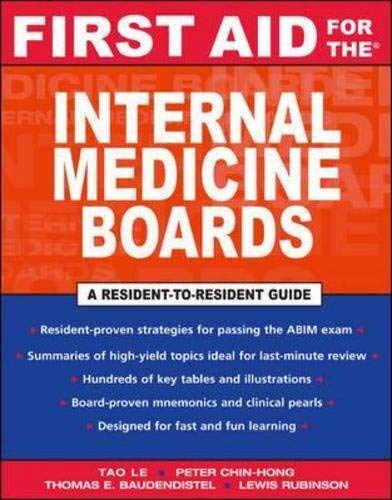
First Aid for the Internal Medicine Boards 4e

Best for Rapid Recall: Internal Medicine Fourth Edition

★ 3.8/5
Tao Le

Who This Is For

Internal medicine residents needing a portable, time-efficient booster for ABIM board prep, especially in the final weeks.

Why It Stands Out

Compact and affordable, with several high-yield algorithms and proven mnemonics that mirror the ABIM blueprint for quick pattern recognition. It scored 4.0 in both curriculum alignment and practical application, making it a strong rapid-review option.

No practice questions and shallow depth mean it cannot stand alone; pair with a Qbank and deeper texts. It is best used as a last-minute refresher, not a primary study source.

Expert Angles

Curriculum Alignment

4.0/5

Directly aligned with the ABIM blueprint, covering thousands of recently tested topics from actual exams. Includes high-yield algorithms and color clinical images.

Excellent for curriculum-based rapid review, but learners should fill gaps with subject-specific board review materials.

Practical Application

4.0/5

Compact, affordable, and designed for repeated passes in the final weeks of study. Easily carried and digested in short sessions.

Ideal for busy residents needing a portable, time-efficient booster to reinforce high-yield facts before the ABIM exam.

Pedagogical Value

4.0/5

Resident-to-resident voice with high-yield mnemonics, algorithms, and bullet summaries. Efficiently organizes complex internal medicine topics for rapid recall.

Best for trainees seeking a structured framework and last-minute refresher, paired with a dedicated Qbank.

First Aid for the Emergency Medicine Boards, Third Edition

Best for Junior Residents: EM Third Edition

★ 2.5/5
Barbara K. Blok, Dickson S. Cheung, Timothy F. Platts-Mills

Who This Is For

Early emergency medicine residents who want a broad overview of the written board blueprint before diving into deeper resources.

Why It Stands Out

Chapter organization follows the EM exam outline, and high-yield tables help frame core topics for initial review.

Outdated protocols and factual errors (like ACLS vasopressin) make it risky for board readiness without heavy supplementation. The book scored low on curriculum alignment (3.0), reference quality (2.0), and learning effectiveness (2.0), meaning it may not reflect current guidelines and could mislead exam preparation. Cross-check every fact with current guidelines.

Expert Angles

Curriculum Alignment

3.0/5

Chapter organization aligns with the EM board exam blueprint, from resuscitation to ethics.

Good as broad overview for junior residents; supplement with current guidelines for board readiness.

Clinical Relevance

2.0/5

Covers core emergency medicine topics in a condensed, exam-focused manner.

Not for clinical decision-making; use as a rapid review only when supplemented with current evidence.

Which First Aid Edition Fits Your Study Style?

Compare these three editions by their strongest use case.

FM Third Edition
First Aid for the Family Medicine Boards, Third Edition
Diana Coffa, Tao Le, Michael Mendoza, Lamercie Saint-Hilaire

Best for visual learners who want a structured, high-retention review with mnemonics and margin notes.

IM Fourth Edition

Best for busy residents who need a portable, rapid-fire refresher before the ABIM exam.

EM Third Edition
First Aid for the Emergency Medicine Boards, Third Edition
Barbara K. Blok, Dickson S. Cheung, Timothy F. Platts-Mills

Best for junior residents who want a broad overview, but accuracy issues limit its value.

Comparison Point First Aid for the Family Medicine Boards, Third Edition First Aid for the Internal Medicine Boards 4e First Aid for the Emergency Medicine Boards, Third Edition
Edition 3 1 3
Page Count 704 pages 1088 pages 1120 pages
Curriculum alignment 4.0 (strong) 4.0 (strong) 3.0 (moderate)
Learning effectiveness 4.0 (high) Not explicitly scored, but practical application is 4.0 2.0 (low)
Practical application Not explicitly scored, but strong alignment suggests good practical use 4.0 (high) Not explicitly scored, but low reference quality suggests poor practical use
Primary strength Strong ABFM alignment, visual design ABIM blueprint, compact EM blueprint organization
Main weakness Guideline lag, no practice questions No practice questions, shallow depth Outdated protocols, factual errors, low reference quality
Curriculum Alignment
4.0/5
18 chapters span community medicine to emergency care, aligning tightly with the ABFM exam blueprint.
Covers core ABFM domains well; verify with latest exam content outlines for gaps.
4.0/5
Directly aligned with the ABIM blueprint, covering thousands of recently tested topics from actual exams. Includes high-yield algorithms and color …
Excellent for curriculum-based rapid review, but learners should fill gaps with subject-specific board review …
3.0/5
Chapter organization aligns with the EM board exam blueprint, from resuscitation to ethics.
Good as broad overview for junior residents; supplement with current guidelines for board readiness.
Learning Effectiveness
4.0/5
Rich with mnemonics, color illustrations, and margin notes that accelerate memorization.
Excellent for cramming; pair with flashcards or Q&As to solidify knowledge.
3.0/5
Mnemonics, comparison tables, and algorithms facilitate pattern recognition and memorization. Useful for rapid review cycles.
Best for reinforcing previously learned material, ideally after studying deeper resources and alongside active …
2.0/5
Mnemonics and visual high-yield tables enhance memory retention for key facts.
Pair with error-free question banks and FOAM resources to reinforce correct information.
If you want a reliable review, start with the FM or IM editions. Avoid the EM edition unless you can verify corrections.

How We Evaluated These Resources

We scored each book on curriculum alignment, learning effectiveness, and practical use. We weighed how quickly you can become productive versus the risk of outdated or incorrect facts. We also considered reviewer feedback on accuracy and usability.

Building Your Resource Collection

Use First Aid as a rapid review layer, not your main textbook. Pair it with a current question bank and a deeper reference like Rosen's or MKSAP. Check the publication date; if it is older than three years, verify guidelines before relying on it.

Final Verdict

First Aid books are efficient for last-minute review, but they are not complete study systems. The FM edition is the safest buy; the IM edition works if you already have a Qbank. The EM edition, however, scored poorly on curriculum alignment, reference quality, and learning effectiveness, so it is not recommended unless you have time to cross-check every fact with current guidelines.

Compare your specialty's edition against current guidelines before you buy.