How to Choose a Surgical Finals Revision Book
Surgical finals need a revision book that matches your exam format. These three books differ in question style, depth, and cost. Pick the one that fits your study habits and exam blueprint.
Find out which surgical finals revision book suits your study style and exam blueprint, with expert scores, trade-offs, and a side-by-side comparison.
Surgical finals need a revision book that matches your exam format. These three books differ in question style, depth, and cost. Pick the one that fits your study habits and exam blueprint.
Final-year medical students preparing for surgical finals who want to practice clinical reasoning in a case-based format.
Uses short clinical scenarios with multiple question formats (SAQs, EMQs, MCQs) covering all surgical subspecialties. Each scenario is designed to mimic real clinical presentations, with questions that test your diagnostic and management decisions in a stepwise manner. The answer sections provide concise feedback on why certain options are correct or incorrect, helping you refine your clinical reasoning.
User-friendly with short questions, multiple formats, and explanatory answers to reinforce learning.
Effective for active recall and exam simulation; combine with current texts.
Comprehensive alignment with undergraduate surgical finals and MRCS syllabi across multiple specialties.
Best used alongside updated resources to ensure curriculum currency.
Multi-format questions (SAQs, EMQs, MCQs) with explanatory answers covering all surgical subspecialties for exam-focused revision.
Ideal for surgical finals and MRCS candidates needing comprehensive, varied question practice.
Penultimate and final-year students who need rigorous EMQ and SBA practice with detailed answer explanations.
Contains five complete papers with 60 SBAs and 30 EMQs each—approximately 450 questions in total. Detailed explanations clarify correct and incorrect answers, with a topic index for targeted revision. The explanations are thorough, often referencing relevant guidelines and anatomical or pathological principles, making it an excellent learning tool beyond just testing.
Repeated testing with immediate, detailed feedback builds durable knowledge and highlights gaps effectively.
Recommended as a supplementary tool to reinforce learning after initial textbook review.
Questions are harder than average finals prep, introducing advanced concepts and nuanced decision-making.
Perfect for high-achieving trainees aiming for honors-level performance and deeper understanding.
Topic index and paper structure align with typical medical finals blueprint, enabling targeted revision by subject.
Excellent for students following UK-style medical curricula seeking high-yield exam rehearsal.
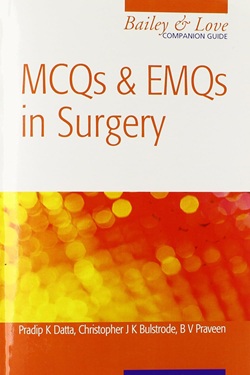
Medical students preparing for surgical finals who want a large question bank for self-assessment and spaced repetition.
Over 1,000 MCQs and EMQs across 13 surgical topics, aligned with Bailey & Love's syllabus. The questions are organized by subspecialty, allowing you to focus on weak areas. The sheer volume makes it ideal for repeated testing and building recall speed.
13 sections mirror the surgical curriculum, covering core learning points as per Bailey & Love.
Recommended for MRCS candidates seeking syllabus-aligned question practice.
Emphasizes self-assessment to reinforce retention and identify knowledge gaps.
Ideal for spaced repetition and testing recall of Bailey & Love content.
Over 1000 questions offer breadth across 13 surgical topics for thorough review.
Use for broad revision; supplement with deeper resources for complex topics.
The right format depends on whether you need clinical reasoning practice or rapid recall testing. The table below summarizes key differences to help you decide at a glance.
Best for building clinical reasoning and applying knowledge to realistic scenarios.
Best for high-yield practice with detailed explanations and exam simulation.
Best for broad coverage and self-assessment, but lacks explanations.
| Comparison Point | Cases for Surgical Finals | EMQs and SBAs for Medical Finals | MCQS AND EMQS IN SURGERY |
|---|---|---|---|
| Edition | 1 | 2 | 1 |
| Page Count | 164 pages | 328 pages | 596 pages |
| Primary strength | Clinical reasoning | Detailed feedback | Breadth of questions |
| Main trade-off | Lower question volume | Limited to UK finals style | No explanations |
| Question count | Not specified (scenario-based) | Approximately 450 (5 papers) | Over 1,000 |
| Format | Clinical scenarios with SAQs, EMQs, MCQs | EMQ and SBA papers | MCQ and EMQ bank |
| Answer explanations | Yes, concise | Yes, detailed | No |
| Best for | Clinical reasoning and application | Exam simulation and detailed learning | High-volume practice and self-assessment |
| Learning Effectiveness |
4.0/5
User-friendly with short questions, multiple formats, and explanatory answers to reinforce learning.
Effective for active recall and exam simulation; combine with current texts.
|
4.0/5
Repeated testing with immediate, detailed feedback builds durable knowledge and highlights gaps effectively.
Recommended as a supplementary tool to reinforce learning after initial textbook review.
|
4.0/5
Emphasizes self-assessment to reinforce retention and identify knowledge gaps.
Ideal for spaced repetition and testing recall of Bailey & Love content.
|
| Curriculum Alignment |
4.0/5
Comprehensive alignment with undergraduate surgical finals and MRCS syllabi across multiple specialties.
Best used alongside updated resources to ensure curriculum currency.
|
4.0/5
Topic index and paper structure align with typical medical finals blueprint, enabling targeted revision by subject.
Excellent for students following UK-style medical curricula seeking high-yield exam rehearsal.
|
4.0/5
13 sections mirror the surgical curriculum, covering core learning points as per Bailey & Love.
Recommended for MRCS candidates seeking syllabus-aligned question practice.
|
We scored each book on learning effectiveness, curriculum alignment, and knowledge depth. We also considered cost per question and how well each format matches common exam styles. The case-based book wins on application, but question banks offer more practice volume. The EMQ/SBA book provides the best balance of practice and explanation, while the MCQ bank is a high-volume but less instructive option.
Pair one question bank with a case-based book for balanced revision. Use the case-based book for weekly practice, and the question bank for timed drills. Skip the MCQ bank if you already have a strong textbook, as its lack of explanations may slow your progress.
For surgical finals, the EMQ/SBA book offers the best balance of practice and explanation, with approximately 450 questions and detailed explanations. The case-based book is a close second for clinical reasoning but has fewer questions. The MCQ bank is a high-volume practice resource for finals, though not MRCS-specific and without explanations.