Key Takeaways

  • High-yield safety concepts require active recall tools, but question banks often miss detailed rationales.
  • Structured outlines align with board blueprints, though outline formats can hinder deep learning of environmental hazards.

High-Yield Occupational Health Concepts: Book Selection Guide

Occupational health demands mastery of safety regulations and environmental hazards. You need books that test your recall of high-yield facts and align with board blueprints. This review compares a question bank against a structured outline to find the right tool for your study goals.
500 MCQs in Occupational Medicine

Best Question Bank: Rapid Recall Practice

★ 4.0/5
Nicholas O'Keeffe

Who This Is For

Trainees preparing for LFOM or board exams who need extensive MCQ practice and active recall drills.

Why It Stands Out

It has 500 exam-style questions in five timed papers, mimicking test conditions and forcing rapid retrieval of core occupational facts. The coverage spans international guidelines, making it useful across jurisdictions.

It lacks detailed answer rationales, so you cannot learn the reasoning behind correct answers or fix conceptual gaps.

Expert Angles

Learning Effectiveness

4.0/5

Repetitive exposure across 500 questions reinforces memory; great for active recall and exam technique.

Excellent supplement for self-testing and identifying knowledge gaps.

Practical Application

4.0/5

Timed paper structure mimics real exam conditions; affordable alternative to expensive online Qbanks.

Best for cost-conscious trainees needing extensive MCQ practice for LFOM/board-style exams.

Curriculum Alignment

3.0/5

Covers broad occupational medicine syllabus with jurisdiction-neutral questions.

Good foundational revision for diploma and LFOM candidates, but pair with advanced materials for difficult exams.

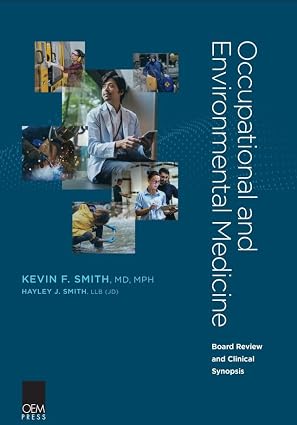
Occupational and Environmental Medicine

Best Outline Notes: Board-Aligned Review

★ 4.2/5
Kevin Smith

Who This Is For

Residency trainees and clinicians who want a portable, write-in review tool aligned with ABPM core content areas.

Why It Stands Out

It organizes high-yield topics around the ABPM blueprint with dense tables and write-in sections. This format supports active learning through annotation and spaced repetition of key environmental health hazards.

The outline format sacrifices explanatory depth, making it difficult for novices to grasp mechanisms or complex case management.

Expert Angles

Curriculum Alignment

5.0/5

Explicitly organized around the five ABPM Core Content Areas for certification, ensuring comprehensive curriculum coverage.

Perfect exam-aligned resource for residency directors and trainees to structure their study plan around official certification requirements.

Learning Effectiveness

4.0/5

Strategic presentation with tables and write-in sections promotes active recall and spaced repetition during board preparation.

Excellent active-learning scaffold for experienced physicians who learn best by annotating and condensing information.

Pedagogical Value

4.0/5

Outline format follows ABPM core content areas, densely packed with summary tables and note-taking space for efficient board exam review.

Best suited for busy physicians needing a structured, rapid-review tool to prepare for the ABPM Occupational Medicine board exam.

Question Bank vs. Structured Outline

Choose based on whether you need to test recall of safety regulations or structure your review around official content areas.

MCQ Practice

High-volume questions for active recall, but no detailed explanations.

ABPM Outline

Blueprint-aligned notes for structured review, but requires existing knowledge.

Comparison Point 500 MCQs in Occupational Medicine Occupational and Environmental Medicine
Edition 1 1
Page Count 230 pages 440 pages
Primary Use Exam simulation and recall drilling Blueprint coverage and personalized notes
Key Trade-off Missing rationales limit learning from errors Outline brevity hinders deep understanding
Learning Effectiveness
4.0/5
Repetitive exposure across 500 questions reinforces memory; great for active recall and exam technique.
Excellent supplement for self-testing and identifying knowledge gaps.
4.0/5
Strategic presentation with tables and write-in sections promotes active recall and spaced repetition during board preparation.
Excellent active-learning scaffold for experienced physicians who learn best by annotating and condensing information.
Curriculum Alignment
3.0/5
Covers broad occupational medicine syllabus with jurisdiction-neutral questions.
Good foundational revision for diploma and LFOM candidates, but pair with advanced materials for …
5.0/5
Explicitly organized around the five ABPM Core Content Areas for certification, ensuring comprehensive curriculum coverage.
Perfect exam-aligned resource for residency directors and trainees to structure their study plan around …
Pick the question bank if you need volume. Pick the outline if you need structure. Most trainees benefit from using both.

How We Evaluated These Resources

We evaluated resources based on alignment with high-yield occupational health concepts and board blueprints. Scores reflect active recall value and limitations in explanatory depth.

Building Your Resource Collection

Start with the outline to structure your review around ABPM core areas. Add the question bank for volume recall drilling and exam simulation.

Final Verdict

The best choice depends on your current weakness in high-yield occupational health concepts. Use the outline for structure and the question bank for recall practice.

Compare both formats against your study timeline before buying.